Range Hood Without a Vent: Your Options
Without an outside vent, your main options are a ductless range hood, a convertible hood run without ducting, or an over-the-range microwave that recirculates air. Each one gives up something a ducted hood provides, mainly venting air outside.
On this page (10 sections)
- What are your options for a range hood without a vent?
- What do no-vent hoods give up compared with a ducted hood?
- Can a range hood without a vent handle a gas range?
- How do you choose among the no-vent options?
- How do you get the best results from a no-vent hood?
- How often should you replace the charcoal filter?
- How do you check the fit before you buy?
- What mistakes should you avoid with a no-vent hood?
- What should renters check before they install a no-vent hood?
- Pick the right range hood without a vent
A range hood without a vent is a hood that keeps cooking air inside the kitchen. It filters the air and sends it back, so no duct to the outside is needed.
That makes it a practical option for rentals, condos and older kitchens with no duct. Our complete ductless range hood guide covers the wider field.
Before you buy, it helps to know what each option gives up, since none of them matches a ducted hood in every way.
What are your options for a range hood without a vent?
You have four main choices: a ductless under-cabinet hood, a convertible hood run without ducting, an over-the-range microwave that recirculates air, or a wall-mount hood. This table covers the first three with a real example of each.
| Option | Example | What it needs | What it gives up |
|---|---|---|---|
| Ductless under-cabinet hood | Broan-NuTone 413004, 30 in, 100 CFM | Its charcoal filter | Outside exhaust |
| Convertible hood, run ductless | CIARRA CAB75918B, 30 in, 200 CFM | The optional CACF006 carbon filter | Simplicity, since you buy one more part |
| Over-the-range microwave | GE JVM3160RFSS, 30 in, 300 CFM | Its replaceable charcoal filter | Flexibility, since hood and microwave are one unit |
An under-cabinet range hood without a vent
A ductless under-cabinet hood filters the air and returns it to the room. What a ductless range hood is explains the grease and charcoal filters in detail.
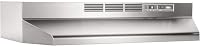
The Broan-NuTone 413004 is the plain example. It's a non-ducted 30 inch hood, 17.5 inches deep, with a two-speed fan and separate rocker switches for the fan and the light.
What you give up is the outside exhaust. The grease filter and the charcoal filter do all of the work, so both need regular attention.
A convertible hood run without ducting
A convertible hood can vent outside or recirculate, which leaves the choice open for later. CIARRA's black 30 inch hood is one example, and it recirculates only when you add its CACF006 carbon filter.
You give up some simplicity, because you buy that filter separately and change it on schedule. The hood itself comes with a 3-prong plug, and CIARRA rates it at 200 CFM and up to 6.5 sones at the top speed.
An over-the-range microwave with recirculating air
GE's 30 inch over-the-range microwave recirculates air through a replaceable charcoal filter, with a 300 CFM rating and two fan speeds. It also heats food, so one unit covers both jobs.
It weighs 40 pounds and measures about 16 inches tall, 30 wide and 15.6 deep. Measure the width and the gap between the cooktop and the cabinet above before you order.
What you give up is flexibility, since replacing the microwave or the hood part means replacing both. For a side-by-side look at a separate hood, read under-cabinet range hood vs microwave.
GE's model number for this microwave is JVM3160RFSS, which is what to search for on the GE Appliances site to find its manual.
A wall-mount hood when there is no cabinet
If no cabinet hangs over the range, an under-cabinet hood has nothing to mount to. A wall-mount hood hangs on the wall above the cooktop instead.
Only some wall-mount hoods recirculate, so confirm the model has a ductless mode and find out which filter it needs. Under-cabinet range hoods without a cabinet sorts out your choices.
What do no-vent hoods give up compared with a ducted hood?
They don't move heat, steam or combustion gases out of the room, and they depend on filters you have to replace. That is the main trade for every option above.
A ducted hood sends air out of the house, so it clears heat and steam from the kitchen. A no-vent option keeps that air inside, and you also take on filter upkeep for the life of the hood.
Do ductless range hoods work? shows what the filters can and can't do.
Can a range hood without a vent handle a gas range?
A hood that vents outside is the stronger choice over a gas range. A no-vent hood still catches grease and helps with odors, but it can't move combustion gases out of the room.
Frequent frying is another reason to lean toward a ducted hood, since frying puts more grease and steam into the air.
Check your range and hood manuals for ventilation advice, and talk to a qualified pro if you're unsure about your setup.
How do you choose among the no-vent options?
Choose by what else the spot has to do, since that narrows the field fast. Find your situation below.
- You want a microwave in the same spot. The over-the-range microwave covers both jobs.
- You only want a hood and the simplest setup. A ductless under-cabinet model fits.
- You might vent outside later. A convertible hood keeps that door open.
- No cabinet hangs over the range. Look at wall-mount models.
- You can't change the wiring. Plug-in models skip it, and the best plug-in ductless range hoods roundup lists them.
How do you get the best results from a no-vent hood?
Turn the fan on before you start cooking, and keep the grease filter clean. Those two habits matter most for a hood that doesn't vent outside.
Starting early means the filters catch steam and grease from the first minute, not after the pan has filled the air. CIARRA suggests low speed for light ventilation, medium for everyday cooking and high for stir-frying.
Empava describes its stainless steel baffle filters as dishwasher safe, so check your manual and wash them as it directs.
How often should you replace the charcoal filter?
Use the interval in your own manual, since makers set their own schedules. CIARRA says its CACF006 filters need replacing every 2 to 4 months, or more often with heavy use.
Write the install date on the filter or on your calendar, so the change doesn't slip. A filter that fits one hood may not fit another, so match the model number before you order.
How do you check the fit before you buy?
Measure the space first, then compare it with the dimensions in the manual. Width sets the coverage, while depth and height decide whether the hood clears the cabinets and the cooktop.
The Empava is about 19.7 inches deep and 29.5 inches wide, with a height of 6.1 inches. The CIARRA black hood is 19.69 inches deep and 3.94 inches tall, which suits a tight space.
Compare those numbers with your own measurements, not with the size name on the box.
What mistakes should you avoid with a no-vent hood?
Most of them come down to a missing part or a number read the wrong way.
- Forgetting the carbon filter. CIARRA's convertible hoods recirculate only with the CACF006 installed.
- Treating CFM as a ductless number. Printed ratings are usually for ducted use, and a charcoal filter slows the air.
- Skipping the depth check. The Broan 413004 is 17.5 inches deep and the Empava is about 19.7, which can matter under a shallow cabinet.
- Buying a microwave only for its fan. If you don't need a microwave, a separate hood is simpler to replace later.
What should renters check before they install a no-vent hood?
Ask your landlord before you mount, wire or drill into anything, since some leases limit changes. A plug-in model avoids the wiring work, so it is usually the easier change to reverse.
CIARRA's black hood comes with a 3-prong plug, and Empava describes its 30 inch hood as plug-in. For the Broan 413004 and the GE microwave, check the manual for how they are wired, since the product details don't say.
Pick the right range hood without a vent
Pick a ductless under-cabinet hood if you want the simplest setup and only need grease and odor control. Pick a convertible model if you may vent later, and an over-the-range microwave only if you need the microwave too.
For a buying checklist, read the buying guide for no-vent kitchens.
Frequently asked questions
Can you have a range hood without a vent?
Yes, a ductless hood, a convertible hood run without ducting and some over-the-range microwaves all pass air through a charcoal filter and return it to the room instead of sending it outside. None of them moves heat or steam out of the kitchen, so plan for that.
Do you need an electrician to install a range hood without a vent?
It depends on the hood, since some plug into a 3-prong outlet and others are hard-wired into a wall box, so check the manual first. Follow the manual, and use a qualified electrician if you're unsure about the wiring or the power supply.
Is an over-the-range microwave a good range hood without a vent?
It can be, if you want a microwave and a hood in one unit. The GE 30 inch model recirculates air through a charcoal filter, weighs 40 pounds and stands about 16 inches tall, so measure the space above your range before you order.
Can you use a range hood without a vent over a gas range?
Ducted is the stronger setup over a gas range, because a hood that vents outside moves combustion gases out of the house. A no-vent hood still catches grease and helps with odors, but it can't clear those gases, so read your range and hood manuals first.