Ductless Range Hood Buying Guide for Non-Vented Kitchens
A ductless range hood is the usual non-vented choice for a kitchen with no outside duct. It catches grease and cooking odors with its filters, then sends the air back into the room.
On this page (14 sections)
- Can you use a non-vented range hood with no outside duct?
- What a non-vented range hood does and does not do
- Non-vented range hood options by type
- Which charcoal filter a non-vented hood needs
- Details to confirm before you order
- Plug-in or hard-wired: what renters should check
- Size, height and clearance for a no-vent hood
- Renters, condos and mobile homes
- Airflow and noise for recirculating hoods
- How often a no-vent hood needs new filters
- When a non-vented hood is not enough
- Setting up a non-vented kitchen step by step
- Non-vented range hood checklist
- Which non-vented range hood to pick
A non-vented range hood has no duct to the outside, so it cleans the air with filters and sends it back into the room. That makes it a common fix for a kitchen where a vent through the wall or roof isn't possible.
This guide explains how these hoods work, where they fit, and which options to compare for a condo, apartment, mobile home or rental. It covers the filters, the power setup and the size checks you'll need before you order.
We compared the specs of four products that cover the main choices, from a plug-in insert to a microwave with a recirculating fan.
New to the idea? The range hood without a vent guide covers your options in plain terms, and the ductless range hoods guide gives the full picture.
Can you use a non-vented range hood with no outside duct?
Yes, a non-vented range hood is made for a kitchen with no outside duct, as long as you use its recirculating setup and change the filters. The hood still does useful work, but it works differently from a ducted hood.
A non-vented hood moves air through a grease filter and a charcoal filter, then returns it to the room. The charcoal filter is the part that needs regular changes, so plan for it from the start.
The terms non-ducted and ductless mean the same thing. A non-vented, non-ducted or ductless hood all recirculate air, so the words describe one setup.
Two common setups are a plug-in insert and an over-the-range microwave with a recirculating fan. Each has trade-offs, so compare them against the same checklist before you buy.
What a non-vented range hood does and does not do
A non-vented hood catches grease and cooking odors with its filters, but it does not remove heat, moisture or combustion gases.
The grease filter catches oil before it reaches the fan, and the charcoal filter works on cooking odors. Both need attention to keep working, so the schedule matters as much as the hood.
Because the air goes back into the room, heat and moisture stay indoors. A non-vented hood can't send combustion gases outside, which is why the setup matters most for a gas range.
For a gas range or heavy frying, a ducted hood that vents outside is the stronger setup. If you have a gas range and no outside vent, check your hood's manual and talk with a pro about your options.
For the full comparison with a ducted hood, read ductless vs ducted range hood.
Non-vented range hood options by type
Most no-vent kitchens use a ductless insert, a plug-in hood or an over-the-range microwave with a recirculating fan. Each type fits a different space and a different level of work.
| Option | Power | Width x height | Airflow | Charcoal filter |
|---|---|---|---|---|
| Empava ductless hood | Plug-in | 29.53 x 6.1 in | 300 CFM, 69 dBA | Not named |
| Broan-NuTone 413004 | Check manual | 30 x 6 in | 100 CFM | Replaceable |
| GE over-the-range microwave | Check manual | 29.88 x 16.13 in | 300 CFM | Replaceable |
Plug-in non-vented range hood options
A plug-in hood avoids new wiring, which suits many renters and condo owners. Its power comes from a standard outlet, so the install is usually simpler than a hard-wired hood.
Empava's 30 inch ductless under cabinet hood is a plug-in model. It runs at 300 CFM on three touch-control speeds and has two LED lights.
Empava says its stainless baffle filters can be washed an unlimited number of times. Empava doesn't name a carbon filter for recirculating mode, so ask Empava or check the manual before you buy.
Its noise rating is 69 dBA, so compare it with the other hoods on your list before you decide. For more plug-in choices, read best plug-in ductless range hoods.
A ductless under cabinet insert
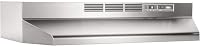
The Broan-NuTone 413004 is a non-ducted insert with a replaceable charcoal filter. It's made to sit under a cabinet, which keeps the hood out of the way.
It's 30 inches wide and 6 inches tall. Broan-NuTone says it should be installed at least 18 inches above the cooktop, so measure that distance before you mount anything.
Its 100 CFM fan has two speeds, and rocker switches control the light and the fan. The light takes a bulb of up to 75 watts, and the bulb isn't included.
Broan-NuTone doesn't name a plug, so check the manual for the power connection before you order. For a full look at this hood, read the Broan-NuTone 413004 range hood review.
An over-the-range microwave with a recirculating fan
An over-the-range microwave with a recirculating fan does two jobs in one unit. It mounts above the range, so it takes the place of a separate hood.
GE's 30 inch microwave has a 300 CFM recirculating fan with two speeds, a replaceable charcoal filter and 1000 watts of cooking power. It also has 10 power levels and a turntable.
It measures 29.88 inches wide, 16.13 inches tall and 15.56 inches deep, so measure the space above the range before you buy. Its charcoal filter needs replacing on a schedule, just like any other ductless setup.
Look up model JVM3160RFSS on the GE Appliances website for its manual and the charcoal filter part.
What each non-vented option gives up
Every option here trades something for working without a vent. The 413004 gives up airflow, since its 100 CFM is the lowest number of the three.
The Empava gives up clarity on filters, since Empava doesn't name the carbon filter for recirculating mode. The GE gives up space, because a microwave 16.13 inches tall takes far more room above the range than a hood about 6 inches tall.
None of the three removes heat, moisture or combustion gases, so the gas range note above applies to all of them.
Which option fits which kitchen
Pick an insert when you already own a microwave, and pick the microwave when you need both appliances and have the space. The Empava is the plug-in pick with the stronger fan, at 300 CFM against the 413004's 100.
Weight is another difference. The 413004 weighs 10 pounds, the Empava 18.7 pounds and the GE microwave 40 pounds, so follow the manual for hardware and get help for the heavy one.
Which charcoal filter a non-vented hood needs
The charcoal filter is the part you'll keep buying, so match it to the model number on your hood. The fit is by model, not by size.
CIARRA's CACF006 is a set of two carbon filters for its ductless models, including the CAS75918A and the CAB75918B. CIARRA says to replace them every 2 to 4 months, or more often depending on use.
The filter twists onto the motor and locks in place, with no tools needed. Check the model first, since the set fits only the CIARRA models it names.
Broan-NuTone's 413004 uses a replaceable charcoal filter for its non-ducted setup, so confirm the part for your exact model in the manual. Empava and GE don't name a separate part number for recirculating use, so check with the maker before you order.
Details to confirm before you order
Three of the four products leave a gap that changes the buying decision, so ask before you order. These are the questions worth sending to the maker.
- Empava: which carbon filter fits recirculating mode, and how often to change it
- Broan-NuTone 413004: the replacement filter number, and whether the hood plugs in or is hard-wired
- GE: the charcoal filter part and change interval for model JVM3160RFSS
The manual often answers all three, and the maker can fill any gap it leaves.
Plug-in or hard-wired: what renters should check
A plug-in hood avoids new wiring, which makes it the simplest route for a rental. Hard-wired hoods connect to the house wiring, so follow the manual and use a qualified electrician if you're unsure.
Don't change wiring in a rental without the owner's approval. If the hood you want is hard-wired, ask a pro to confirm the power before you buy.
Size, height and clearance for a no-vent hood
Match the hood to your cooktop width, and check the height above the cooktop before you mount it. The two inserts here are about 30 inches wide, to match a 30 inch range.
The Empava is 29.53 inches wide and 6.1 inches tall. The Broan-NuTone 413004 is 30 inches wide and 6 inches tall, so both sit low under the cabinet.
Check the height rule in each manual before you mount anything. The GE microwave is 29.88 inches wide and 16.13 inches tall, so it needs its own clear space above the range.
Renters, condos and mobile homes
If you can't change a wall or roof, a ductless or plug-in hood is usually the first option to check. Renters and condo owners often need to avoid drilling into a roof or wall, so a ductless setup is a common route.
Check your lease or association rules before you drill or run any wiring. Those rules can decide which hood you can install, so read them before you shop.
Mobile homes may have rules for roof and wall openings, so ask the park or a local pro before you cut anything. A non-vented hood can still be the right fit once the rules are clear.
Airflow and noise for recirculating hoods
Read the CFM number as a guide for a recirculating hood, and compare the noise rating at the top speed you'll use. Maker airflow numbers are usually measured for ducted use, and airflow in ductless mode is often lower.
The Empava is rated at 300 CFM and 69 dBA, and the GE's recirculating fan is rated at 300 CFM. The Broan-NuTone 413004 is rated at 100 CFM, which is a lower number, so check it against the way you cook.
The Empava has three speeds and the GE has two, so both let you pick a setting for the job. Noise matters most at the top speed, since a quiet low setting doesn't tell you how the hood sounds under load.
How often a no-vent hood needs new filters
Change the charcoal filter on a schedule, and clean the grease filter as your manual says. The two filters do different jobs, so they don't follow the same routine.
CIARRA says its carbon filters need changing every 2 to 4 months, or more often with heavy use. Use that range as a starting point, then adjust it to how often you cook.
A stronger cooking smell in the kitchen is a sign the charcoal may be due for a change. Keep a note of the date you changed it, so the next change is easy to plan.
Grease filters are often washable, but check the manual for the cleaning method and how often to do it.
When a non-vented hood is not enough
For a gas range or heavy frying, a ducted hood that vents outside is the stronger setup, so add one if you can. A non-vented hood catches grease and odors, but it doesn't remove heat, moisture or combustion gases.
Those gases and that moisture stay in the kitchen instead of leaving through the hood. If you cook with gas every day, that's a good reason to look at a vented option first.
If a vent is impossible, a non-vented hood still helps with grease and odors. Use the fan while you cook and keep the filters clean, since both keep the hood working.
Setting up a non-vented kitchen step by step
Work through these steps in order, from measuring the space to your first filter change.
- Measure the cooktop width and the space above it, and write the numbers down.
- Check your lease or association rules before you drill or run any wiring.
- Choose a plug-in insert, a ductless insert or a microwave, based on your power setup.
- Confirm the filter part for your model number before you order.
- Install the hood using the manual, and use a qualified electrician for any wiring you're unsure about.
- Set a reminder for the first filter change, and note the date on your card.
Non-vented range hood checklist
Check these items before you order, so the hood fits your space and your filter plan. Each one is a number or a choice you can confirm in the manual.
- Cooktop width and the space above it
- Height rule from the manual
- Plug-in or hard-wired, and your lease or association rules
- Filter type and the model number for replacement
- Charcoal filter change schedule
- Noise rating at the top speed you'll use
- Airflow in CFM, read as a rough guide for ductless use
Check the manual for each hood before you buy, since ductless parts and power setups differ.
Which non-vented range hood to pick
Choose a plug-in insert when you want no new wiring, and a microwave when you want one appliance for both jobs.
Pick the Empava if you want a plug-in hood with touch controls, and check the recirculation filter with the maker first. Pick the Broan-NuTone 413004 if you want a non-ducted insert with rocker switches and a replaceable charcoal filter.
Confirm the 413004's power setup in the manual before you order. Pick the GE microwave if you want one unit for cooking and recirculating ventilation, and measure the space above the range first.
Pick the CIARRA filters only if your hood is one of the CIARRA models they fit. For a shortlist of hoods to compare, see best ductless range hoods.
Frequently asked questions
Can you use a range hood without a vent?
Yes, a non-vented range hood cleans the air with filters and sends it back into the room. It needs a charcoal filter for that job, the filter has to be changed on a schedule, and it doesn't do the work of a vent for heat or moisture.
Does a non-vented range hood remove smoke and fumes?
It catches grease and cooking odors with its filters, but it doesn't remove heat, moisture or combustion gases. For a gas range or heavy frying, a ducted hood that vents outside is the stronger setup, so check your manual and ask a qualified pro if you're unsure.
Is a plug-in range hood good for a rental?
A plug-in hood avoids new wiring, which suits many renters and condo owners, but check your lease before you install anything. Some plug-in models still need a charcoal filter for recirculating use, so confirm the parts and the power setup in the manual before you buy.
Is a non-vented range hood the same as a ductless one?
Yes, the terms describe the same setup, since a non-vented or non-ducted hood recirculates air the way a ductless hood does. The main things to check are the charcoal filter, which needs regular changes, and whether the hood needs a plug or a hard wire.